AI Superpowers — Kai-Fu Lee
Summary in 15 minutes. How losing a board game pushed an entire country into the AI race. China’s own internet universe, the two countries’ different paths, and the four waves of AI. Not a robot uprising — for Lee the real risk is jobs and inequality. And the answer lies in the human heart. You’ve read the book. Now map your own work onto the four zones — and sharpen your human side.
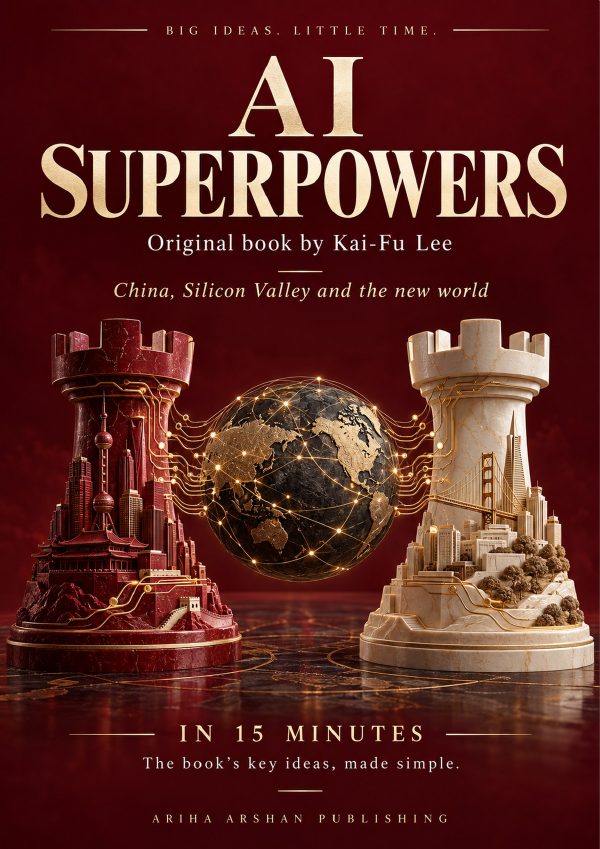
Key ideas of "AI Superpowers: China, Silicon Valley, and the New World Order"
China Wakes Up
How losing a board game pushed an entire country into the AI race.
- China’s Sputnik Moment: One game, one nation’s wake-up call
- From Discovery to Implementation: The rules of the AI game have changed
- From Copycats to Gladiators: How China’s entrepreneurs learned to fight
Two Superpowers
China’s own internet universe, the two countries’ different paths, and the four waves of AI.
- China’s Alternate Internet Universe: Wallets in phones, and businesses that “go heavy”
- A Tale of Two Countries: Governments, seven giants and two strategies
- The Four Waves of AI: One after another — each one different
The Real Crisis, the Real Lesson
Not a robot uprising — for Lee the real risk is jobs and inequality. And the answer lies in the human heart.
- Neither Utopia nor Dystopia: The real AI crisis
- Which Jobs Are at Risk: Two measures, four zones
- The Wisdom of Cancer: The illness that changed how Lee thinks
- A Blueprint for Coexistence: AI does the analysis, humans bring the love
- Looking Back from 2026: Our note: what held up, what didn’t
Put It into Practice
You’ve read the book. Now map your own work onto the four zones — and sharpen your human side.
- The 7-Day Plan: One task a day. Tick it off when done.
- One-Page Cheat Sheet: The whole book at a glance — save it
- Final Word — Heart over Calculation: The human place in the machine age
From the free first chapter
Kai-Fu Lee calls this China’s “Sputnik moment” — the equivalent of 1957, when the Soviet satellite Sputnik shocked America into the space race. Within two months, in July 2017, China’s government announced its goal: to become the world’s leading center of AI innovation by 2030.
Lee is an insider to this story. He did pioneering speech-recognition research at Carnegie Mellon, then worked at Apple and Microsoft and ran Google China, before founding his own Beijing-based venture firm, Sinovation Ventures. Few people know both countries’ tech worlds as closely.
Read the first chapter free · Price: ৳250 · or every book with a membership
Common questions
What is "AI Superpowers: China, Silicon Valley, and the New World Order" about?
How losing a board game pushed an entire country into the AI race. China’s own internet universe, the two countries’ different paths, and the four waves of AI. Not a robot uprising — for Lee the real risk is jobs and inequality. And the answer lies in the human heart. You’ve read the book. Now map your own work onto the four zones — and sharpen your human side.
What are the key ideas of "AI Superpowers: China, Silicon Valley, and the New World Order"?
China’s Sputnik Moment; From Discovery to Implementation; From Copycats to Gladiators; China’s Alternate Internet Universe; A Tale of Two Countries; The Four Waves of AI; Neither Utopia nor Dystopia; Which Jobs Are at Risk; The Wisdom of Cancer; A Blueprint for Coexistence; Looking Back from 2026; The 7-Day Plan.
Who wrote "AI Superpowers: China, Silicon Valley, and the New World Order"?
Kai-Fu Lee.
How long does the Gistbook summary take to read?
About 15 minutes. It is available in English and Bangla, and the first chapter is free.