Four Thousand Weeks — Oliver Burkeman
Summary in 15 minutes. You can’t do it all. Once you accept that, the real choosing can begin. A life is what we pay attention to. Yet we lose that attention to the pull of our screens, to our own discomfort and to worry about the future. Slowing the rush of impatience, sharing time with others, and finding relief in our own smallness. You’ve read it. Now let some things go on purpose, and give your full attention to what remains.
Key ideas of "Four Thousand Weeks: Time Management for Mortals"
Choosing to Choose
You can’t do it all. Once you accept that, the real choosing can begin.
- Four Thousand Weeks: Life is alarmingly short
- The Efficiency Trap: The faster you go, the more arrives
- Becoming a Better Procrastinator: The question is what to leave undone
Attention and Control
A life is what we pay attention to. Yet we lose that attention to the pull of our screens, to our own discomfort and to worry about the future.
- Attention Is Life: Where your attention goes, your life goes
- The Intimate Interrupter: Distraction also comes from within
- We Never Really Have Time: Worry about the future, and losing the present
- Rediscovering Rest: Leisure that doesn’t have to be useful
Patience, People and the Cosmos
Slowing the rush of impatience, sharing time with others, and finding relief in our own smallness.
- Staying on the Bus: The impatience spiral and three principles of patience
- The Loneliness of the Digital Nomad: Time is worth more when it’s shared
- Cosmic Insignificance Therapy: You are small, and that’s a relief
Put It to Work
You’ve read it. Now let some things go on purpose, and give your full attention to what remains.
- Ten Tools: From the book’s appendix: practical ways to embrace your finitude
- Your 7-Day Plan: One task a day. Tick it off when done.
- One-Page Cheat Sheet: The whole book at a glance. Save it.
- Final Word: Freedom Within Limits: A short life, fully attended to
From the free first chapter
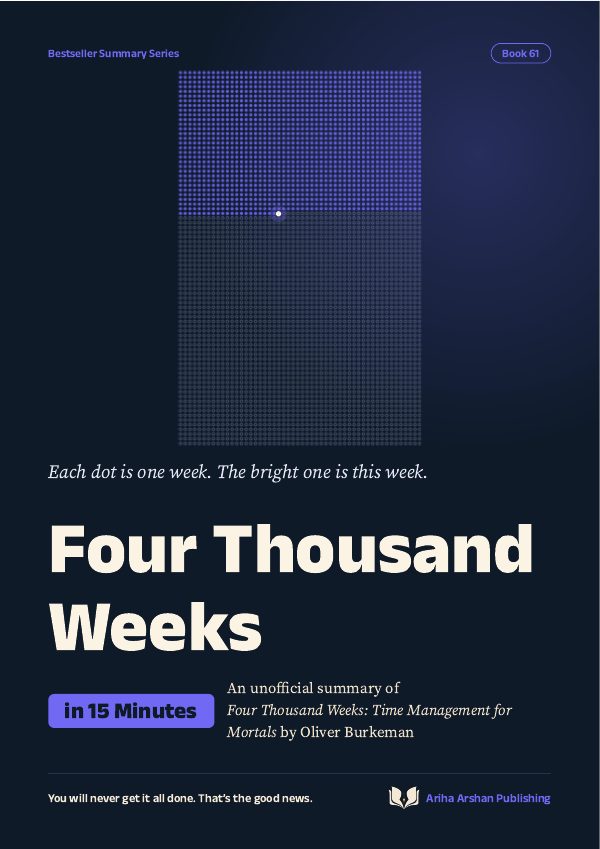
For years Oliver Burkeman wrote a psychology column for The Guardian, and by his own account he was a productivity geek: every new app, every new system. The work never ran out. So the book starts with the arithmetic most time-management books skip. If you live to eighty, you get about four thousand weeks.
Drawing on the philosopher Martin Heidegger, Burkeman argues that we don’t have time the way we have a bank balance. We are time. Being finite is the basic fact of human life, so every choice of one path means giving up countless others. The word “decide” comes from a Latin root meaning “to cut off.”
Read the first chapter free · Price: ৳250 · or every book with a membership
Common questions
What is "Four Thousand Weeks: Time Management for Mortals" about?
You can’t do it all. Once you accept that, the real choosing can begin. A life is what we pay attention to. Yet we lose that attention to the pull of our screens, to our own discomfort and to worry about the future. Slowing the rush of impatience, sharing time with others, and finding relief in our own smallness. You’ve read it. Now let some things go on purpose, and give your full attention to what remains.
What are the key ideas of "Four Thousand Weeks: Time Management for Mortals"?
Four Thousand Weeks; The Efficiency Trap; Becoming a Better Procrastinator; Attention Is Life; The Intimate Interrupter; We Never Really Have Time; Rediscovering Rest; Staying on the Bus; The Loneliness of the Digital Nomad; Cosmic Insignificance Therapy; Ten Tools; Your 7-Day Plan.
Who wrote "Four Thousand Weeks: Time Management for Mortals"?
Oliver Burkeman.
How long does the Gistbook summary take to read?
About 15 minutes. It is available in English and Bangla, and the first chapter is free.